Articles
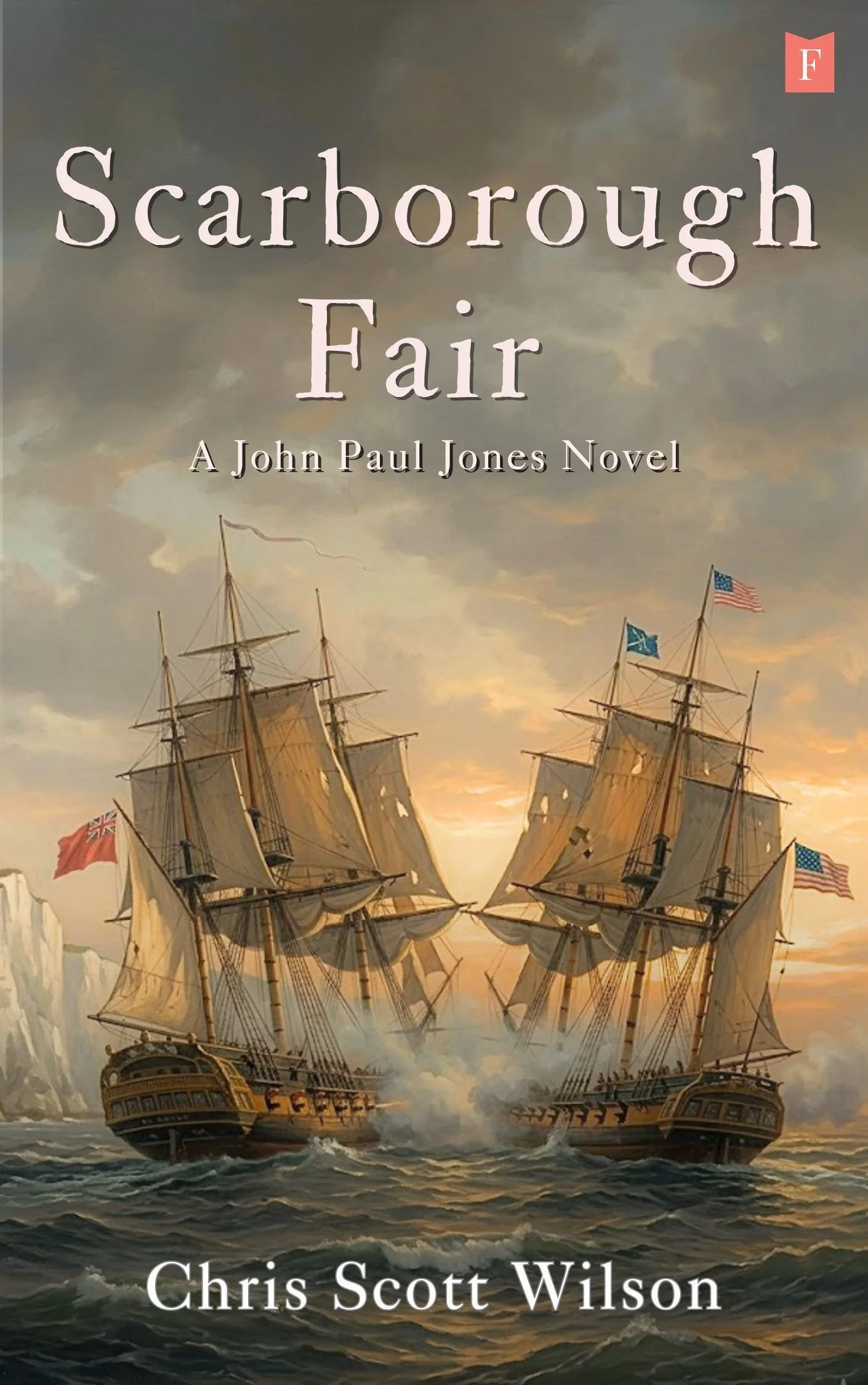
How I came to Write Scarborough Fair
by Chris Scott Wilson
Researching the local history of the North Yorkshire coast I came across a report that when John Paul Jones sailed past the whaling seaport of Whitby in 1779 the militia opened fire from the town battery. However, out of use for so long, when the cannons were fired in anger the vibrations actually destroyed the battery, which collapsed over the cliffs. My interest sparked, I started to look into John Paul Jones. No Google then, no internet, computers scarce, and no other means of research but ordering books from the British Library, taking them, out on loan, then requesting books from that author’s bibliography and making copious notes in longhand. Samuel Eliot Morrison was the authority on Jones at the time and his book was invaluable.
Irrefutably, history is always written by the winners. While John Paul Jones is lauded in American records, and rightly so, virtually their Nelson, he is basically ignored in English historical accounts, often merely referred to as a pirate, or even as a turncoat due to his Scots heritage - being a first generation American during the War of Independence - or worse, lampooned. But credit must be given where it is due. He accomplished almost the unthinkable – he challenged the might of His Majesty’s Britannic Navy with no disgrace.
What made John Paul Jones interesting? He could remain focused in spite of all the distractions around him. Commanding a sailing ship is no small task, yet captaining a fighting ship manned by a multi-national crew, officered by Americans and policed by French marines must have been a nightmare. Add the problems of commanding a flotilla of vessels all captained by men used to taking independent action. It is often said a thin line exists between genius and lunacy. Exactly how one defines that line depends on the reference points of the observer's perception. During warfare, if an outrageous attempt is made to accomplish an objective and succeeds, the commander then becomes a hero, decorated and promoted. But if he fails, then he is written off as an idiot purely for failing to do exactly the same thing. The failures we try to forget, the heroes never.
England's greatest entry into the naval history books, Nelson, tried a radical (at the time) approach in sea battles and gained victories by dismissing the then tried and tested standard rules of engagement. He gave the ultimate sacrifice for his country - his life, and dying from his wounds at the hour of his greatest victory crystallised and magnified his legend. John Paul Jones gained no such immediate recognition. The more I read, the more interested I became.
The mechanics of writing? No computers or word processors. Every word was written longhand, corrected and rewritten as it was typed up in batches. Re-read, amended, and re-typed, a top copy for submission, and two carbon copies. That repetitive process provides thinking time, especially for the writer’s phobias. What did I forget? Is this historically correct? The labour of typing also acts as a brake to further editing. On computer one can edit and rewrite forever.
Advancing technology may have helped me, but not so bestselling author Clive Cussler who at the time I was writing Scarborough Fair, funded what was ultimately an unsuccessful search for the wreck of John Paul Jones' ship Bonhomme Richard which sank after the battle off Flamborough Head. Today, she still lays out there somewhere. A couple of years later, somehow, somewhere, in America or in a cabin aboard another search vessel at sea, Clive read my book and sent me a letter delivered one snowy Christmas Eve.
“Scarborough Fair is a terrific story. You have a beautiful way with words. Of course, you English always had a better command of the language than we Colonists. The Serapis and Bonhomme Richard battle was always a great adventure tale and you did it proud,” he wrote. A few words that meant everything.
The best Christmas present I ever received.